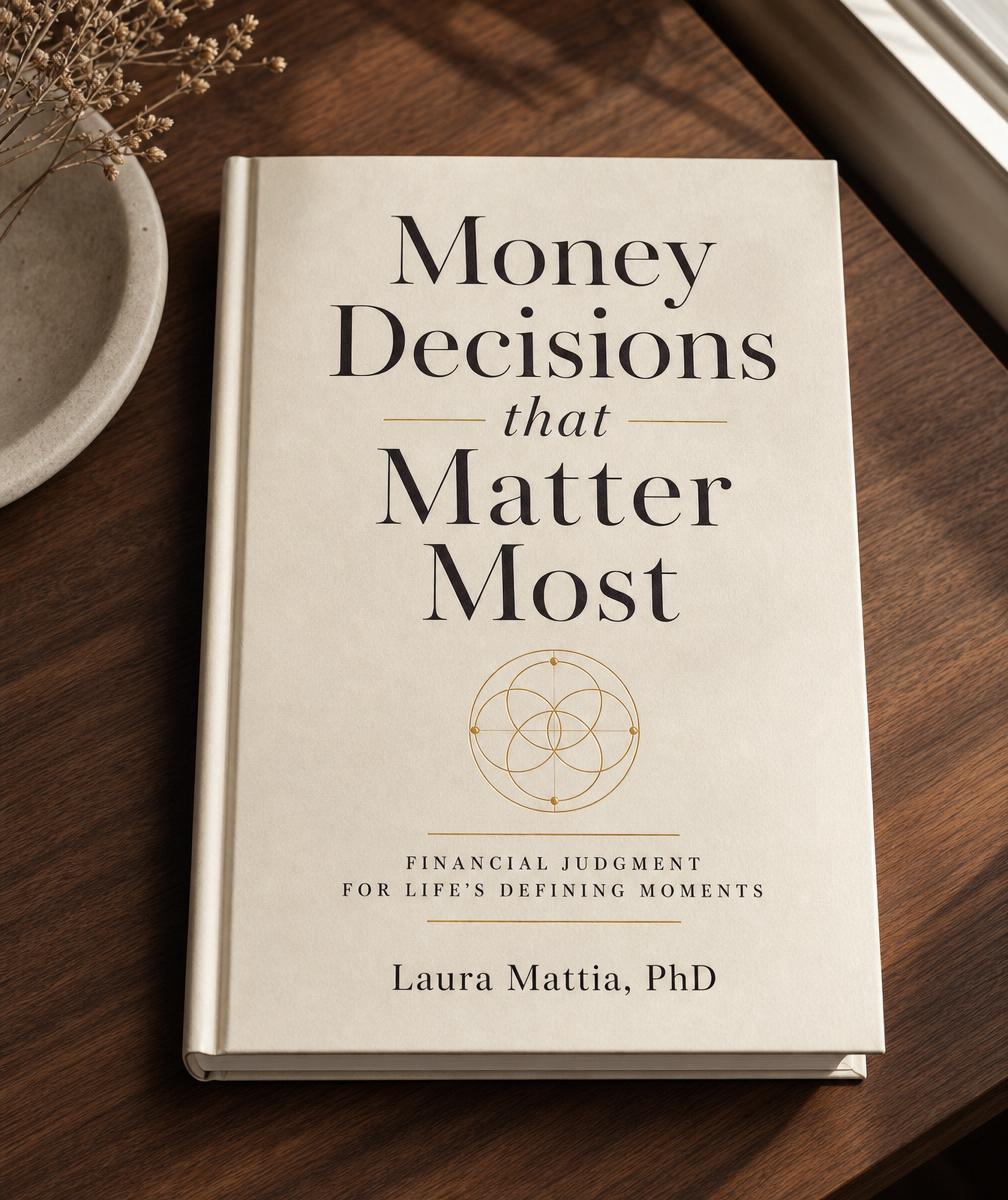
Cover of The Money Decisions that Matter Most by Laura Mattia, PhD
New release

The Money Decisions that Matter Most

Getting Life's Biggest Financial Choices Right

By Laura Mattia, PhD · [Publisher] · [Pub date] · [Format details]

Purchase — coming soon

Purchase links will be activated once the book is published.

Synopsis

This book begins from the question that has shaped Laura Mattia's work across research, teaching, and practice: how people make consequential financial decisions when the future is not fully knowable. Money decisions are rarely isolated or purely technical — they arise where identity, family, memory, incentives, fear, and time converge, determining where people live, how they work, whom they can help, and how much freedom they have.

Effective financial judgment, Dr. Mattia argues, is not primarily a function of intelligence, wealth, or confidence. It depends on the quality of the lens a person brings to the decision. This is why one-size-fits-all advice so often fails: a rule may capture an average pattern, but no individual is average. Good decision-making requires understanding why a rule exists, what assumptions it depends on, and whether those assumptions fit your own constraints and goals.

Organized around five decision frameworks — and illustrated throughout by Ava and Leo, a couple navigating career, family, retirement, and caregiving — the book offers a way of thinking rather than prescriptions to be followed uncritically. Each chapter includes Decision Insights (reflection prompts) and Decision Points (working exercises) so readers can interpret their circumstances, ask better questions, and make decisions that stay sound as conditions change.

Inside the book

Five decision frameworks

Each framework addresses a different category of financial judgment, from the choices that shape daily life to the systems that protect long-term execution. Together they form a structured path for deciding well under uncertainty.

Part One

Values-to-Decisions Framework

Before a single number is run, something quieter is already steering the outcome: belief, confidence, and habit. Part One surfaces the hidden forces behind money decisions, then builds a framework that translates what you value into goals you can actually act on.

Contents
  1. Chapter 1 — The Hidden Forces Behind Your Money Decisions

    • We Have Met the Enemy and It Is Us
    • Limiting Beliefs
    • Misapplied Confidence
    • Mental Shortcuts
    • Awareness Fuels Alignment
  2. Chapter 2 — Values: Where Money Meets Meaning

    • A Value-Driven Plan Turns Stress into Strength
    • Follow Your North Star
    • Values Are a Lived Principle
  3. Chapter 3 — The Values-to-Decisions Framework

    • Two Honest Mirrors
    • Spending Your Money
    • Spending Your Time
    • Converting Values into Goals
    • Living Well Through Alignment
    • From Values to SMART Goals (the Bridge)
    • The Time Is Now
Part Two

Decision Triage Framework

Not every financial problem deserves your attention today. Part Two reads the vital signs — cash flow and net worth — then triages: what is urgent, what is quietly weakening the system, and what will expand your options later.

Contents
  1. Chapter 4 — Monitoring Your Lifeblood: The Cash Flow Statement

    • Financial Vital Signs
    • Income
    • Expenses (Outflows)
    • Net Cash Flow (Surplus or Deficit)
  2. Chapter 5 — Lab Reports: The Personal Net Worth Statement

    • Your Financial Story
    • What to Know About Ownership
    • The Fluctuating Nature of Net Worth
  3. Chapter 6 — The Decision Triage Framework

    • Question 1: What Is Urgent?
    • Reading Immediate Pressure
    • Building Protection for Emergencies
    • Reducing the Burden of Debt
    • Question 2: What Is Weakening the System?
    • Using Benchmarks to Spot Strain
    • Question 3: What Will Expand Future Options?
    • Analyzing Large Asset Holdings
  4. Chapter 7 — Protection, Provisioning, and Prevention Framework

    • Protection
    • Provisioning
    • Prevention
Part Three

Investment Decision Framework

Investing well is less about picking winners than about matching money to time. Part Three explains how markets set prices, what risk actually feels like on the way down, and how to build and document a portfolio strategy that survives both markets and life.

Contents
  1. Chapter 8 — Investing Fundamentals

    • High Stakes Efficiency
    • The Real Power Couple: Money and Time
    • Time Is Money, Literally: The Time Value of Money
  2. Chapter 9 — Understanding the Ride, Not Just the Return

    • The Roller Coaster Ride of Risk & Return
    • Losses Change the Math
    • The Vocabulary of Risk: Key Measurement Tools
    • Understanding Your Portfolio's Behavior
  3. Chapter 10 — Reduce the Risk, Keep the Return

    • Modern Portfolio Theory
    • The Efficient Frontier
    • Asset Classes and Risk
    • Portfolio Construction
    • One Asset Class Portfolio
    • Two Asset Class Portfolio
    • Multi-Asset Class Portfolio
  4. Chapter 11 — The Investment Policy Statement

    • The Purpose of a Documented Investment Strategy
    • Rebalancing: Buy Low / Sell High
    • Monitoring Performance: IRR & TWR
    • The Blueprint for Responsible Investing
Part Four

Life Transition Decision Frameworks

Retirement, widowhood, and divorce are not ordinary planning moments — they alter income, identity, responsibility, and the choices still available. Part Four offers decision models for knowing what to decide now, what to delay, and which tradeoffs shape the life that comes next.

Contents
  1. Chapter 12 — The Retirement Decision Model

    • Define the Life You Are Retiring To
    • Decide Whether It Is Time
    • Translate Your Vision of Retirement into Financial Terms
    • Weighing Costs & Benefits with Purpose & Priorities
  2. Chapter 13 — Irrevocable Decisions

    • Pension Payout
    • Social Security
    • Additional Critical Considerations
    • Annuities
    • The Illusion of Safety
  3. Chapter 14 — Income That Lasts a Lifetime

    • Retirement Income Sources
    • Investments as a Source of Income
    • Shifting from Accumulation to Withdrawal
    • Tax Efficiency
    • Special Considerations (IRMAA, QCD, Roth Conversions)
    • Balanced-but-Brittle
  4. Chapter 15 — When “We” Becomes “Me” Decision Model

    • The New Financial Baseline After Loss
    • Decision Strategies During Widowhood
    • Decision Strategies During Divorce
    • High Impact Decisions and Timing
    • The House
    • Retirement Accounts
    • Social Security
    • All in Good Time
Part Five

Authority, Instructions, and Alignment Framework

Good plans fail at execution. Part Five prevents that by clarifying who decides, how decisions are carried out, and how alignment is maintained — through documents, taxes, family complexity, and legacy given while you are still here to see it. Unclear authority destroys good plans.

Contents
  1. Chapter 16 — Effective Estate Planning

    • The Framework
    • Preparing Your Goals
    • Assembling Your Trusted Advisory Team
  2. Chapter 17 — Who Can Act and What Guides Them

    • Last Will and Testament
    • Power of Attorney
    • Living Will
  3. Chapter 18 — Where Plans Break Down

    • Dying Without a Will
    • When a Will Is Outdated
    • When a Will Is Contested
    • Why a Will Does Not Control Everything
  4. Chapter 19 — Preserving Values Through Estate and Tax Planning

    • Why Taxes Change the Story
    • Retirement Accounts: The Hidden Tax Multiplier
  5. Chapter 20 — Family Circumstances and Estate Decisions

    • Minor Children
    • Estranged Relationships
    • Blended Families
    • Special Needs Dependents
    • Family Businesses
  6. Chapter 21 — Legacy in Action

    • When Giving Strengthens Family and Well-Being
    • Choosing How the Family Will Give Together
    • Charitable Gifts of Your IRA
Advance praise

[Placeholder endorsement — one to two sentences from a reviewer or fellow author speaking to the book's contribution.]

[Reviewer name], [Publication or affiliation]

[Placeholder endorsement — a distinct voice, perhaps from academia, praising the rigor of the work.]

[Reviewer name], [Institution]

[Placeholder endorsement — a practitioner or advisor speaking to the book's practical value for readers navigating major decisions.]

[Reviewer name], [Firm or role]
Press & mentions
  • [Publication][Headline or excerpt from press coverage — placeholder text will be replaced with actual mentions.][Date]
  • [Publication][Headline or excerpt from press coverage — placeholder text will be replaced with actual mentions.][Date]
  • [Publication][Headline or excerpt from press coverage — placeholder text will be replaced with actual mentions.][Date]